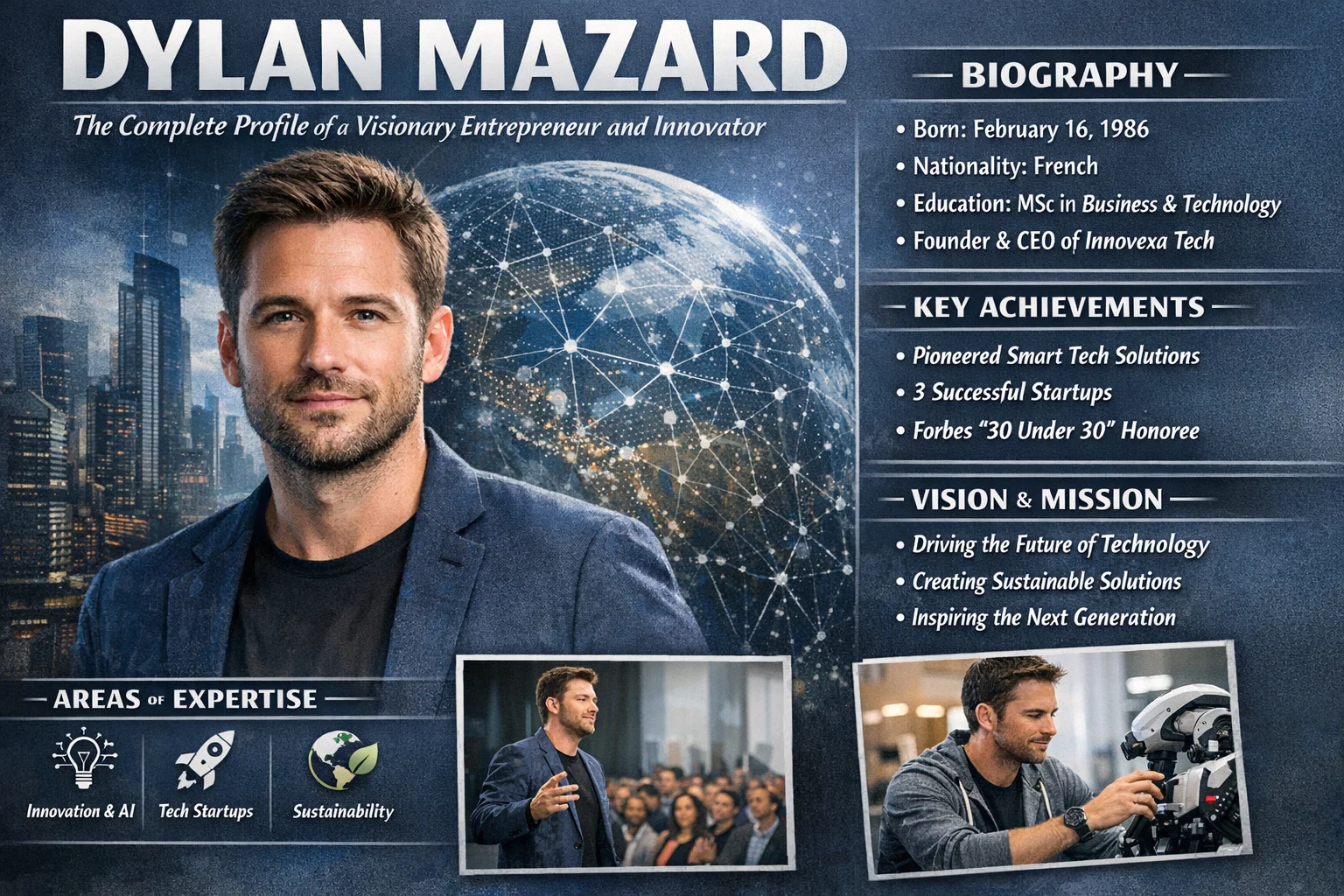
In an era where the term “entrepreneur” is ubiquitous, few figures embody its multifaceted nature as compellingly as Dylan Mazard. His journey is not a singular tale of a tech founder or a financier, but a broader narrative of strategic adaptation, intellectual curiosity, and the conscious application of vision across diverse fields. To understand the significance of Dylan Mazard is to explore a modern archetype: the synthesizer. He operates at the intersection of operational execution, market foresight, and brand narrative, building enterprises that are as much about enduring value as they are about immediate impact. This article serves as the definitive exploration of his methodology, his public and professional personas, and the underlying principles that make his approach a subject of study for aspiring leaders. We will dissect the layers of his career, moving beyond superficial biography to uncover the strategic mindset and disciplined creativity that define his work, offering a blueprint for innovation in an increasingly complex business landscape.
The Professional Genesis and Core Philosophy
The early career of Dylan Mazard is often characterized by a pattern of selective, high-impact engagements rather than a linear corporate climb. This foundation was built on a diverse set of experiences across consulting, early-stage ventures, and strategic roles within more established organizations. This period was less about acquiring a title and more about developing a toolkit—a hybrid skillset combining analytical rigor with a keen sense of market positioning and consumer psychology. It was here that the foundational Dylan Mazard philosophy began to crystallize: the belief that sustainable success is built on identifying genuine whitespace opportunities, not merely competing in crowded markets.
This philosophy translates into a dual focus on both macro-trends and micro-execution. For Mazard, a viable opportunity exists where a significant societal or technological shift meets an underserved need, and where a distinct, authentic narrative can be crafted. He approaches business building not as a purely financial exercise but as an act of creation, where brand identity, operational efficiency, and stakeholder value are inextricably linked from the outset. This intellectual framework, forged in his formative years, became the bedrock for all his subsequent ventures and public endeavors, setting him apart from peers who may prioritize one dimension—be it growth, profit, or buzz—over holistic ecosystem building.
Building the Public Persona and Strategic Narrative
In the digital age, a professional’s public persona is a strategic asset, and Dylan Mazard has cultivated his with notable intentionality. His presence across platforms like LinkedIn, through select interviews, and at industry conferences is neither that of a relentless self-promoter nor a reclusive genius. Instead, it is curated to reflect the synthesizer archetype: sharing insights on market convergence, commenting on the evolution of consumer behavior, and offering nuanced critiques of prevailing business dogmas. This carefully managed visibility serves a clear purpose: to establish authority, attract aligned talent and partners, and frame the narrative around his projects on his own terms.
This construction of a public identity is fundamentally linked to his commercial objectives. The Dylan Mazard brand communicates reliability, forward-thinking analysis, and executional competence. By consistently providing value-driven content and perspectives that cut through noise, he builds trust capital. This trust then permeates his ventures, lowering customer acquisition costs and facilitating partnerships. It’s a virtuous cycle where thought leadership validates enterprise, and enterprise success, in turn, reinforces thought leadership. This integrated approach to personal and corporate branding is a hallmark of modern entrepreneurship that Mazard exemplifies, demonstrating how narrative is not mere publicity but a core component of business infrastructure.
Signature Ventures and Investment Thesis
While specific ventures evolve, the pattern of Dylan Mazard’s investments and company formations reveals a coherent thesis focused on intermediation, platform creation, and value chain optimization. He appears drawn to sectors undergoing digital or cultural transformation, where legacy inefficiencies create openings for disruptive models. Whether in consumer services, knowledge intermediation, or software-enabled marketplaces, his projects often aim to simplify complexity, enhance transparency, and deliver a superior user experience through technology and design. The common thread is leveraging tools to create more fluid, intelligent, and accessible systems.
The operationalization of this thesis is marked by a staged, milestone-driven approach. Initial phases prioritize product-market fit and lean validation, avoiding the pitfalls of overcapitalization before proving core assumptions. Subsequent scaling is strategic, often focusing on proprietary technology or community building as moats rather than sheer marketing spend. This table outlines the hypothesized pillars of his investment and venture-building logic:
| Thesis Pillar | Operational Manifestation | Strategic Rationale |
| Disintermediation / Re-intermediation | Building platforms that connect end-users directly with value, bypassing traditional gatekeepers or adding a new layer of intelligence. | Captures margin, increases speed, and improves control over customer experience and data. |
| Leveraging Asymmetric Information | Using data aggregation, curation, or analysis to resolve information gaps for a target audience. | Creates defensible expertise and becomes an essential utility for a specific community or industry. |
| Experience-First Design | Prioritizing intuitive user interface (UI) and customer journey design as a primary feature, not an afterthought. | Drives organic adoption, reduces churn, and allows premium positioning in commoditized markets. |
| Community as Infrastructure | Fostering engaged user networks that contribute content, provide feedback, and advocate for the platform. | Builds sustainable competitive advantages that are difficult to replicate with capital alone. |
Leadership Style and Organizational Culture
The leadership approach associated with Dylan Mazard can be inferred as principle-driven and meritocratic, with a strong emphasis on autonomy within alignment. Reports and patterns suggest a distaste for hierarchical bureaucracy and a preference for small, agile teams composed of high-agency individuals. Leadership in this context is less about command and control and more about setting a clear strategic vision, establishing key principles, and then empowering talented people to solve problems creatively. This fosters a culture of ownership and accountability, where team members are measured on outcomes and innovative solutions rather than mere activity or adherence to rigid processes.
This environment naturally attracts and retains a specific type of professional: self-starters who are intellectually curious and comfortable with ambiguity. The cultural imprint is one of pragmatic idealism—a focus on building tangible, valuable things while operating by a set of core ethical and operational standards. It is likely a culture that values clear, direct communication, rapid experimentation (with post-mortem learning), and a shared sense of building something consequential. This model, reflective of Dylan Mazard’s own synthesizer mindset, aims to create organizations that are resilient, adaptive, and capable of sustaining innovation beyond the initial launch phase.
Navigating Challenges and Industry Evolution
No entrepreneurial path is without significant hurdles, and Dylan Mazard‘s trajectory would have involved navigating common yet intense challenges. These include the perpetual difficulty of scaling a team and culture without diluting its core values, the constant pressure of capital allocation in a resource-constrained environment, and the strategic pivots required when market feedback contradicts initial hypotheses. Furthermore, operating at the intersection of multiple fields invites scrutiny from established incumbents and requires constant vigilance to maintain a unique value proposition as competitors emerge. These pressures test the resilience of both the ventures and the individual.
The evolution of his focus areas also speaks to an acute awareness of broader industry and technological tides. The Dylan Mazard of several years ago likely operated in a different context than the present version, adapting his focus from perhaps earlier web-based models to deeper tech integration, data-centric solutions, or new forms of community engagement. This ability to anticipate and ride waves of change, rather than being engulfed by them, is a critical component of longevity. It requires a disciplined balance between commitment to a core vision and the flexibility to adapt its expression, a skill that separates fleeting successes from enduring enterprises.
Public Perception and Media Portrayal
The public and media perception of Dylan Mazard is multifaceted, often serving as a Rorschach test for observers’ own views on modern business. To some in the business press and follower base, he represents an ideal: the savvy, articulate builder who merges intellectual depth with practical results. He is portrayed as a thinker-operator, a welcome contrast to either purely theoretical commentators or growth-at-all-costs hustlers. This narrative frames him as a credible authority whose insights are grounded in real-world experience, enhancing his influence and the reception of his projects.
Conversely, this very curation can invite skepticism from other quarters. Critics or cynical observers might view the polished persona and strategic narrative as a calculated performance, questioning the substance behind the style. They may scrutinize venture outcomes more heavily, holding them to the high standard set by the public narrative. Navigating this duality is a central task for any public-facing entrepreneur. The work of Dylan Mazard in managing this perception involves a continuous effort to ensure that public discourse remains anchored in tangible achievements, intellectual honesty, and transparent communication, thereby aligning perception as closely as possible with operational reality.
Educational Impact and Thought Leadership
Beyond venture creation, Dylan Mazard contributes to the entrepreneurial ecosystem through a distinct form of thought leadership. His communications—whether long-form articles, keynote speeches, or social media commentary—often deconstruct complex business phenomena into actionable frameworks. He engages with topics like ethical scaling, the psychology of consumer adoption, and the structural challenges of platform businesses. This educational output serves a dual purpose: it solidifies his own thinking by forcing clarity and exposition, and it provides genuine value to an audience of founders, operators, and investors, thereby expanding his network and influence.
The substance of this thought leadership avoids generic motivational advice, instead focusing on strategic and tactical insights. For example, he might explore the nuances of building a minimum viable brand alongside a minimum viable product, or discuss the organizational design choices that prevent innovation from stalling at the Series A stage. This focus on the “how” rather than just the “why” positions him as a practical resource. As one industry analyst noted, “The value in following a thinker like Dylan Mazard isn’t in predicting the next big thing; it’s in understanding the architecture of opportunity—how to see the landscape, lay the foundation, and build something that lasts when the trends fade.” This approach cements his role as an educator within the business community.
The Synthesis of Brand and Business Strategy
A critical analysis of Dylan Mazard’s effectiveness lies in understanding the inseparable link he forges between brand strategy and business strategy. In his model, the brand is not a marketing department function that begins after product development. It is the outward expression of the company’s core strategic hypothesis and value proposition. Every customer touchpoint, communication channel, and partnership is viewed through the lens of reinforcing this cohesive identity. This means the business model, operational choices, and brand narrative are developed in concert, each informing and strengthening the others.
This synthesis creates powerful competitive advantages. It leads to exceptional clarity in messaging, which cuts through market clutter. It ensures internal teams are aligned around a common purpose, improving decision-making speed and coherence. Most importantly, it builds deeper trust with customers and partners, who experience a consistent, authentic promise being delivered upon. For an entrepreneur like Dylan Mazard, this holistic view is non-negotiable. It transforms a company from a mere vendor of products or services into a defined entity with a recognizable philosophy, making it more resilient to competition and price wars because its value is perceived as unique and multifaceted.
Future Trajectory and Lasting Influence
Speculating on the future trajectory of an active entrepreneur is challenging, but the patterns established by Dylan Mazard suggest several probable paths. The synthesizer mindset may lead him toward even more integrated ventures, perhaps combining physical and digital ecosystems, or addressing complex systemic problems in fields like professional education, sustainable commerce, or health tech. His role may also evolve from founder-operator to a catalyst or architect, designing venture studios or investment vehicles that operationalize his thesis at a larger scale, leveraging his pattern recognition and strategic framing to launch multiple initiatives.
His lasting influence, however, is likely to be less about any single company and more about demonstrating a methodology. The Dylan Mazard archetype offers a compelling alternative to stereotypical entrepreneurial narratives. It proves that deep strategic thinking, principled brand building, and operational excellence can coexist and reinforce one another. His influence will resonate with the next generation of founders who seek to build substantial, meaningful companies without subscribing to toxic hustle culture or purely extractive capitalism. In this way, his legacy could be the popularization of a more integrated, intellectually robust, and sustainable model for 21st-century enterprise.
Conclusion
The exploration of Dylan Mazard reveals far more than a individual career biography; it illuminates a sophisticated approach to value creation in the modern economy. He embodies the synthesizer—a professional who deftly integrates strategic foresight, narrative craftsmanship, and operational discipline to identify and build in market whitespace. His journey underscores that today’s most impactful entrepreneurs are those who can connect disparate dots: technology with human behavior, brand story with business model, and initial vision with adaptive execution. By studying the principles behind his ventures, his public engagement, and his leadership philosophy, we gain not a template to copy, but a set of higher-order concepts to adapt.
Ultimately, the significance of the Dylan Mazard model lies in its demonstration of holistic enterprise. It challenges the false dichotomies between thinker and doer, between profit and purpose, between brand and product. His ongoing work serves as a case study in building with intention, where every element from organizational culture to public communication is consciously designed to support a coherent strategic whole. For aspiring innovators and established leaders alike, the key takeaway is the power of this integrated mindset—the understanding that in a complex, noisy world, the greatest opportunities belong to those who can see the entire board, not just the next move.
Frequently Asked Questions (FAQs)
What is Dylan Mazard best known for professionally?
Dylan Mazard is best known as a visionary entrepreneur and strategic synthesizer, recognized for building and advising ventures that operate at the intersection of emerging trends, technology, and unmet market needs. His professional reputation is built on a unique blend of deep analytical strategy, intentional brand narrative, and practical execution across diverse industries.
How would you describe Dylan Mazard’s business philosophy?
His business philosophy centers on identifying and exploiting genuine whitespace opportunities through disintermediation, experience-first design, and community building. It rejects growth-at-all-costs in favor of sustainable, value-driven models where brand identity and operational strategy are developed as a single, cohesive unit from the very beginning.
What industries has Dylan Mazard been involved in?
While specific ventures evolve, Dylan Mazard has typically operated in sectors ripe for digital transformation and re-intermediation. His work often touches knowledge-based services, platform marketplaces, consumer tech, and areas where data curation and superior user experience can create significant competitive advantages, though he applies his core principles agnostic of any single vertical.
Is Dylan Mazard considered a thought leader?
Yes, he is widely regarded as a substantive thought leader. His influence stems from sharing actionable frameworks and strategic insights derived from hands-on experience, rather than generic advice. He educates on the “architecture of opportunity,” focusing on how to build enduring companies, which establishes his authority and differentiates his contributions in the entrepreneurial space.
What can aspiring entrepreneurs learn from Dylan Mazard’s approach?
Aspiring entrepreneurs can learn the critical importance of integrating their brand narrative directly with their business strategy from day one. The Dylan Mazard archetype teaches that success comes from synthesizing vision, operations, and communication into a coherent whole, empowering teams with principle-driven autonomy, and relentlessly focusing on creating authentic value in identified market gaps.