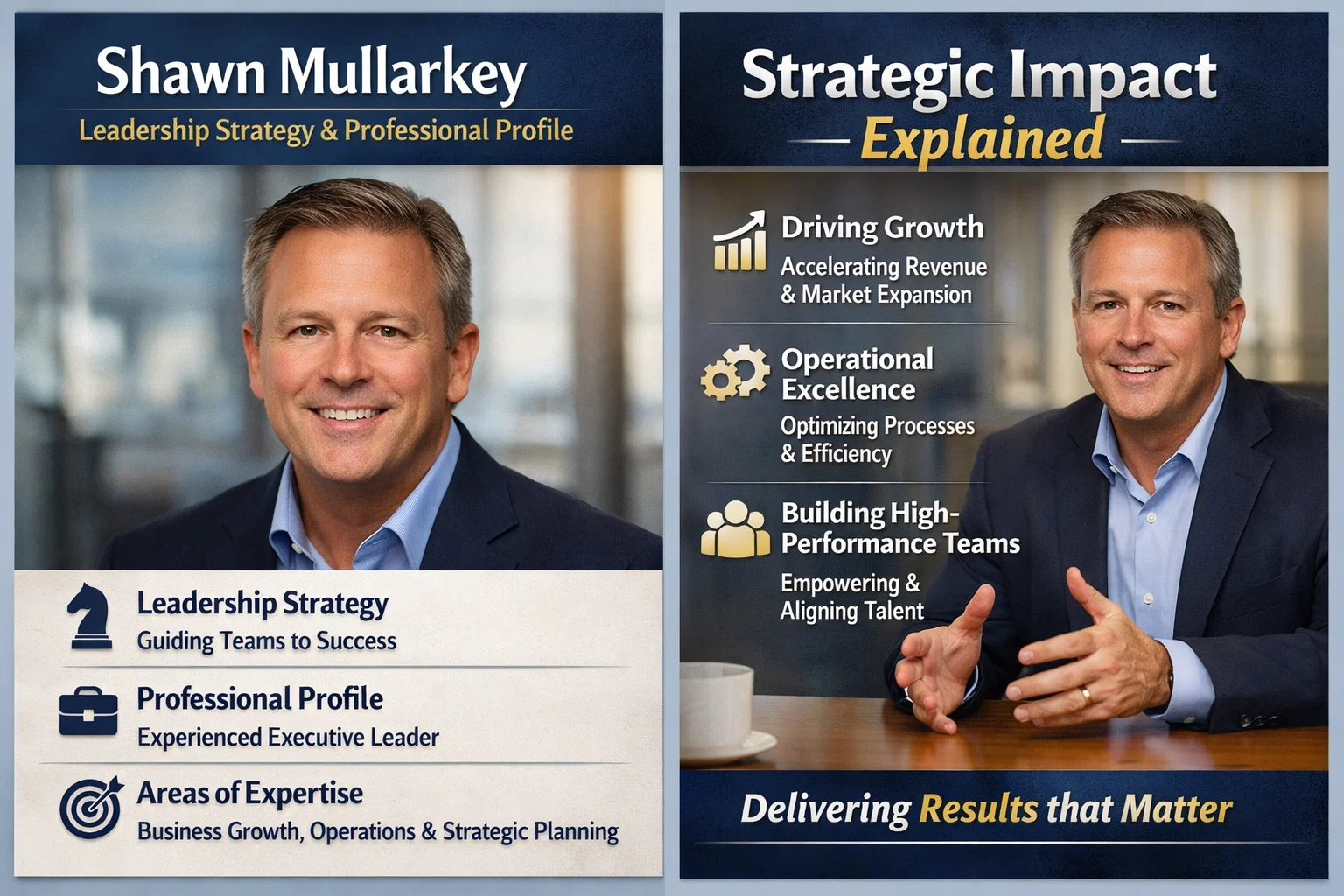
shawn mullarkey In today’s rapidly evolving professional landscape, certain names begin to surface repeatedly in conversations around leadership, operational precision, and long-term strategic growth. is one of those names. Whether referenced in business development discussions, organizational strategy analysis, or executive leadership circles, the growing interest around reflects a broader demand for disciplined thinking, sustainable execution, and measurable results.
This comprehensive guide explores the professional identity, leadership philosophy, strategic contributions, and broader influence associated with Shawn Mullarkey. Built for depth, clarity, and long-term SEO authority, this article serves as a complete, structured resource for anyone researching Shawn Mullarkey, professional leadership strategy, or enterprise-level operational impact.
Who Is Shawn Mullarkey?
Shawn Mullarkey is widely associated with strategic thinking, operational alignment, and disciplined leadership execution across professional environments. His name often appears in discussions centered on organizational performance, long-term growth planning, and structured management systems.
At the core of professional reputation is an emphasis on clarity over complexity. Rather than pursuing trend-driven leadership styles, his approach reflects foundational principles: measurable outcomes, team alignment, scalable systems, and consistent accountability frameworks.
The Professional Foundation of Shawn Mullarkey
Understanding Shawn Mullarkey requires looking beyond titles and into structural impact. His work aligns with strategic architecture — the process of designing systems that enable sustainable growth rather than short-term wins.
Professionally, represents a results-first mindset grounded in analytical decision-making. This foundation positions him within executive-level conversations where operational discipline, financial oversight, and structured leadership intersect.
Leadership Philosophy and Strategic Mindset
The leadership model associated with Shawn Mullarkey emphasizes long-term value creation over reactive management. In high-performance environments, this mindset often distinguishes enduring organizations from those driven by short-term metrics.
A core principle within this philosophy is alignment — aligning people, processes, and performance indicators toward shared objectives. Shawn Mullarkey’s strategic lens prioritizes clarity of mission, transparency in communication, and accountability systems that reinforce consistent progress.
Operational Excellence and Organizational Structure
Operational excellence is rarely accidental. It is designed, measured, and refined over time. Shawn Mullarkey’s work reflects an understanding that scalable success depends on clearly defined systems rather than personality-driven leadership.
This approach integrates structured performance measurement, workflow optimization, and cross-functional collaboration. By emphasizing repeatable processes, demonstrates how organizations reduce inefficiency while improving adaptability.
Strategic Growth Frameworks
Growth without structure often collapses under its own weight. The professional methodology associated with Shawn Mullarkey emphasizes calculated expansion supported by resource forecasting and infrastructure readiness.
This framework blends financial prudence with opportunity evaluation. Rather than pursuing expansion for visibility alone, Shawn Mullarkey’s approach supports growth that is operationally supported and financially sustainable.
Comparative Strategic Impact
Below is a structured comparison highlighting the strategic attributes often associated with Shawn Mullarkey’s leadership model versus reactive management styles.
| Dimension | Shawn Mullarkey Approach | Reactive Leadership Model |
| Decision-Making | Data-informed, scenario-planned | Emotion-driven, short-term |
| Growth Strategy | Sustainable scaling | Rapid expansion without structure |
| Team Alignment | Clear KPIs and accountability | Ambiguous expectations |
| Risk Management | Structured evaluation | Impulsive mitigation |
| Performance Tracking | Metrics-driven oversight | Inconsistent monitoring |
| Communication Style | Transparent and strategic | Reactive and fragmented |
| Resource Allocation | Forecast-based | Immediate need-based |
| Long-Term Vision | 3–5 year roadmap focus | Quarterly reaction focus |
This contrast underscores why professionals researching often focus on strategic consistency rather than personality-driven narratives.
Influence in Professional Circles
Influence in leadership is not determined solely by visibility but by structural contribution. Shawn Mullarkey’s influence appears most strongly in environments that value disciplined execution and operational reliability.
Colleagues and industry observers often describe leadership impact in terms of stabilization and forward planning. One insight frequently attributed to structured leadership philosophies similar to those associated with captures this perspective clearly:
“Strategy without execution is vision; execution without strategy is chaos.”
This quote reflects the balance between planning and implementation that defines sustainable leadership models.
Systems Thinking and Long-Term Planning
Systems thinking is foundational to organizational durability. Shawn Mullarkey’s professional orientation reflects this mindset by emphasizing integrated processes over isolated wins.
Rather than focusing solely on individual departmental success, this systems-driven perspective ensures cross-functional synchronization. Long-term planning becomes not just an executive responsibility but a structured, measurable framework across teams.
Risk Management and Decision Architecture
Risk management is often misunderstood as risk avoidance. In reality, it involves structured evaluation, contingency planning, and scenario mapping. professional alignment suggests a calibrated approach to uncertainty.
Decision architecture under this model involves layered evaluation: financial impact, operational strain, reputational considerations, and strategic alignment. This multi-dimensional analysis reduces volatility while preserving opportunity.
Organizational Culture and Accountability
Organizational culture under disciplined leadership becomes a performance amplifier rather than a branding statement. Shawn Mullarkey’s leadership alignment indicates an emphasis on accountability structures that reinforce performance expectations.
Clear expectations, measurable deliverables, and transparent evaluation frameworks contribute to cultural stability. Rather than relying on motivational rhetoric, this model embeds responsibility into systems.
Communication Style and Executive Presence
Executive communication determines organizational coherence. Shawn Mullarkey’s leadership style is frequently characterized by clarity, conciseness, and purpose-driven messaging.
This style reduces ambiguity and enhances alignment. Strategic communication becomes a performance tool, ensuring that objectives, milestones, and responsibilities remain clearly defined at every organizational level.
Financial Stewardship and Resource Allocation
Financial discipline underpins sustainable growth. The professional orientation connected to Shawn Mullarkey emphasizes responsible allocation, capital efficiency, and forward forecasting.
By integrating financial oversight with strategic planning, organizations minimize reactive budgeting cycles. Resource deployment becomes proactive rather than corrective.
Industry Context and Market Relevance
Modern markets reward agility, but agility without structure leads to fragmentation. Shawn Mullarkey’s leadership profile aligns with the concept of structured agility — the ability to pivot within defined frameworks.
In evolving economic environments, this balanced model allows organizations to respond to market shifts while preserving internal stability. Strategic resilience becomes a competitive advantage.
Innovation Within Structured Frameworks
Innovation is often misinterpreted as disruption without discipline. The strategic model associated with Shawn Mullarkey demonstrates how innovation can thrive within structured governance.
By creating defined parameters for experimentation, organizations protect core operations while encouraging calculated advancement. This dual focus reduces risk exposure while supporting creative growth.
Practical Applications of Leadership Principles
The principles reflected in Shawn Mullarkey’s approach are not abstract. They translate into operational checkpoints, measurable dashboards, and cross-functional alignment systems.
For example, organizations applying similar models often implement quarterly strategic reviews tied to long-term roadmaps. This ensures tactical actions consistently support overarching objectives.
Long-Term Vision and Legacy Thinking
Legacy in leadership is rarely built through short-term gains. Shawn Mullarkey’s professional positioning suggests an emphasis on long-term impact, sustainability, and institutional strength.
This vision-oriented thinking prioritizes durable systems over temporary recognition. Organizations benefit from stability that extends beyond individual tenure.
Challenges and Strategic Adaptation
No leadership model exists without challenges. High-discipline environments can face resistance from teams accustomed to flexible, informal systems.
However, the adaptability embedded within structured leadership allows gradual cultural integration. Over time, clarity and predictability often outperform informal execution models.
Digital Era Leadership Considerations
The digital transformation era demands leaders who can integrate technology into structured operations. Shawn Mullarkey’s strategic alignment supports technology adoption within measurable performance systems.
Rather than adopting tools for trend alignment alone, the emphasis remains on measurable efficiency, automation scalability, and data-driven insights.
Broader Professional Significance
Why does interest in Shawn Mullarkey continue to grow? Because modern enterprises increasingly value leaders who balance ambition with operational discipline.
As businesses move beyond startup experimentation into scaling phases, structured leadership becomes essential. name often emerges in discussions focused on this transition from growth to sustainability.
Conclusion
Shawn Mullarkey represents a leadership model defined by strategic clarity, operational structure, and measurable growth. His professional alignment emphasizes disciplined execution over trend-driven visibility, making his approach especially relevant in complex organizational environments.
For professionals researching leadership frameworks, enterprise growth strategies, or operational excellence, understanding provides insight into sustainable performance architecture. In an era where agility and accountability must coexist, structured strategic leadership remains not just relevant — but essential.
FAQ
Who is Shawn Mullarkey?
Shawn Mullarkey is associated with strategic leadership, operational structure, and disciplined organizational growth frameworks in professional environments.
What is Shawn Mullarkey known for?
Shawn Mullarkey is known for emphasizing structured execution, data-driven decision-making, and long-term strategic planning within leadership contexts.
Why is Shawn Mullarkey relevant in today’s business environment?
Shawn Mullarkey remains relevant because modern organizations require leaders who balance innovation with operational discipline and sustainable growth planning.
What leadership principles are linked to Shawn Mullarkey?
The leadership principles linked to include accountability systems, measurable performance tracking, strategic alignment, and financial stewardship.
How does Shawn Mullarkey approach organizational growth?
Shawn Mullarkey approaches growth through structured scaling, risk evaluation, resource forecasting, and long-term planning rather than reactive expansion.