
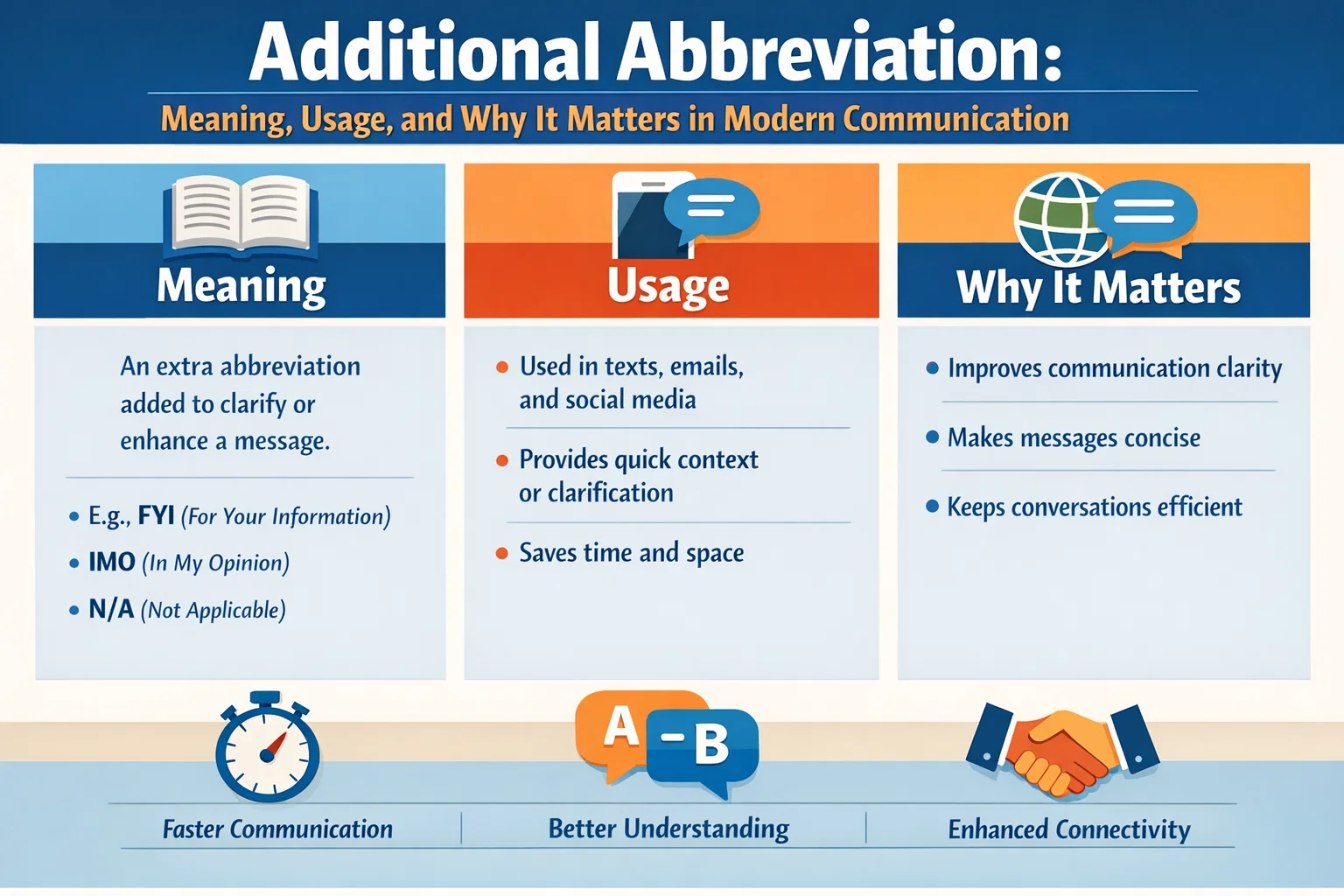
Language constantly adapts to speed, context, and clarity, and abbreviations are one of its most practical tools. Among them, additional abbreviation stands out as a concept that quietly shapes professional writing, digital communication, and everyday documentation.
This guide explores how abbreviations labeled as “additional” function, why they exist, and how to use them correctly without sacrificing clarity. Whether you write formally or casually, understanding this topic can significantly improve how your message is received.
Understanding What an Additional Abbreviation Is
An additional abbreviation refers to a shortened form of a word or phrase that supplements, rather than replaces, an already established abbreviation or full term. It often appears when extra clarity, differentiation, or contextual precision is required.
In practice, these abbreviations arise in technical fields, legal documents, academic writing, and digital systems where space, speed, or repetition matters. They coexist with primary abbreviations and help readers navigate complex or repetitive information efficiently.
Why Additional Abbreviations Exist
Modern communication demands efficiency, especially in environments where long phrases repeat frequently. Additional abbreviations help reduce redundancy while maintaining comprehension across lengthy documents or conversations.
They also emerge when a single term has multiple interpretations. By introducing an extra abbreviated form, writers can reduce ambiguity and ensure readers understand exactly which concept is being referenced.
Historical Evolution of Abbreviation Usage
Abbreviations date back to ancient scripts, where scribes shortened common phrases to save time and materials. Over centuries, these shorthand practices evolved into standardized systems across languages and professions.
As fields specialized, the need for layered shorthand grew. became a natural response to increasingly complex terminology, especially in science, law, and engineering.
Additional Abbreviation in Professional Writing
In professional documents, additional abbreviations are often introduced after the primary term has already been defined. This allows writers to reference subcategories or variations without repeating lengthy explanations.
Used correctly, this technique improves readability and demonstrates subject mastery. Used poorly, it can confuse readers, which is why clear definitions and consistency are critical.
Academic and Research Contexts
Academic writing frequently introduces additional abbreviations to distinguish between related theories, datasets, or methodologies. This allows researchers to discuss nuanced differences efficiently.
Journals and style guides often regulate how and when such abbreviations may appear. Following these conventions ensures clarity and maintains academic credibility.
Digital Communication and Technology
In software documentation and user interfaces, space is limited and clarity is essential. abbreviations help developers label functions, settings, or processes without overwhelming users.
They are also common in coding environments, where variable names and comments benefit from concise but distinct shorthand that avoids overlap with existing terms.
Business and Corporate Usage
Businesses rely heavily on abbreviations in internal communications, reports, and presentations. Additional abbreviations often emerge organically within teams to represent new initiatives or variations of existing processes.
When documented properly, they streamline collaboration. When left undefined, they can alienate new team members or external stakeholders.
Legal and Regulatory Documents
Legal writing is notorious for repetition and precision. Additional abbreviations allow drafters to reference specific clauses, entities, or conditions efficiently across long contracts.
Because legal interpretation depends on exact language, these abbreviations must be introduced clearly and used consistently throughout the document.
Healthcare and Medical Fields
Medical professionals use layered abbreviations to communicate quickly and accurately. Additional abbreviations often distinguish between similar conditions, treatments, or measurements.
In this context, clarity can be a matter of safety. For that reason, many healthcare institutions maintain strict abbreviation guidelines.
Linguistic Perspective on Abbreviations
From a linguistic standpoint, abbreviations are a form of lexical compression. represent a secondary layer of this process, adapting language to evolving communicative needs.
They illustrate how language balances efficiency with meaning, especially in environments where precision and speed are equally valued.
Common Misconceptions About Additional Abbreviations
A frequent misconception is that more abbreviations always improve efficiency. In reality, excessive shorthand can overwhelm readers unfamiliar with the context.
Another misunderstanding is that additional abbreviations are informal. In truth, they are widely used in formal, regulated, and academic settings when applied correctly.
Best Practices for Introducing Additional Abbreviations
The first mention should always include the full term, followed by the abbreviation in parentheses. This establishes clarity before shorthand is used repeatedly.
Consistency matters just as much. Switching between forms or inventing new abbreviations mid-document undermines reader trust and comprehension.
When to Avoid Additional Abbreviations
Short documents or communications with broad audiences often benefit from minimal abbreviation use. In these cases, clarity outweighs brevity.
If an abbreviation will appear only once or twice, introducing it may create unnecessary cognitive load rather than saving effort.
Industry Variations and Standards
Different industries adopt different norms around abbreviations. What is acceptable in engineering documentation may be discouraged in marketing copy.
Understanding your audience and their expectations helps determine whether an additional abbreviation will enhance or hinder understanding.
International and Cross-Cultural Considerations
Abbreviations do not always translate well across languages or cultures. Additional abbreviations can be especially challenging for non-native readers.
In global communication, writers should weigh the benefits of brevity against the risk of misunderstanding and provide glossaries when necessary.
Role in Search and Information Retrieval
In digital systems, abbreviations affect how information is indexed and retrieved. Additional abbreviations can improve search precision when mapped correctly to full terms.
Poorly documented shorthand, however, can fragment data and make retrieval less reliable across platforms.
Structured Overview of Abbreviation Types
The table below highlights how additional abbreviations compare with other common forms of shorthand in written communication.
| Type | Purpose | Typical Context | Risk Level |
| Primary abbreviation | Replace a long term | General writing | Low |
| Additional abbreviation | Add clarity or distinction | Technical fields | Medium |
| Acronym | Create pronounceable shorthand | Branding, organizations | Low |
| Initialism | Letter-by-letter reference | Formal documents | Low |
| Informal shorthand | Speed and convenience | Casual messaging | High |
This comparison shows that additional abbreviations occupy a middle ground between efficiency and complexity.
A Note from an Editorial Perspective
“As language becomes more specialized, clarity depends less on avoiding abbreviations and more on using them responsibly.” This observation reflects how professional writers balance precision with accessibility.
Editorial judgment plays a crucial role in deciding when an extra layer of abbreviation truly serves the reader.
Future Trends in Abbreviation Usage
Automation, AI, and data-driven systems increasingly rely on standardized shorthand. Additional abbreviations are likely to grow as systems become more complex and interconnected.
At the same time, tools that automatically expand or explain abbreviations may reduce the cognitive burden on readers.
Practical Takeaways for Everyday Writers
For most writers, the key is intentionality. Use additional abbreviations when they genuinely improve flow or clarity, not simply to sound technical.
A simple glossary or parenthetical explanation can make even complex shorthand accessible to a wider audience.
Ethical and Accessibility Considerations
Accessibility guidelines increasingly encourage plain language. Excessive abbreviation use can exclude readers with cognitive or language-processing challenges.
Balancing efficiency with inclusivity ensures communication remains effective for diverse audiences.
Conclusion
Additional abbreviations are a powerful linguistic tool when used thoughtfully and sparingly. They reflect how modern communication adapts to complexity without abandoning clarity.
By understanding their purpose, context, and limitations, writers can use this technique to enhance precision while keeping readers engaged and informed.
Frequently Asked Questions
What does additional abbreviation mean?
An additional abbreviation is a secondary shortened form introduced to add clarity or distinction beyond a primary term, helping readers follow complex information more easily.
Is additional abbreviation considered formal writing?
Yes, additional abbreviation is commonly used in formal and professional contexts when defined clearly and applied consistently.
How often should I use an additional abbreviation?
It should appear only when repetition or complexity justifies it. Overuse can reduce clarity rather than improve it.
Can additional abbreviation affect SEO?
When used thoughtfully and supported by full terms, additional abbreviation can support semantic relevance without harming readability.
Should I define additional abbreviation every time?
No, it only needs to be defined at first mention, after which consistent usage maintains understanding.