
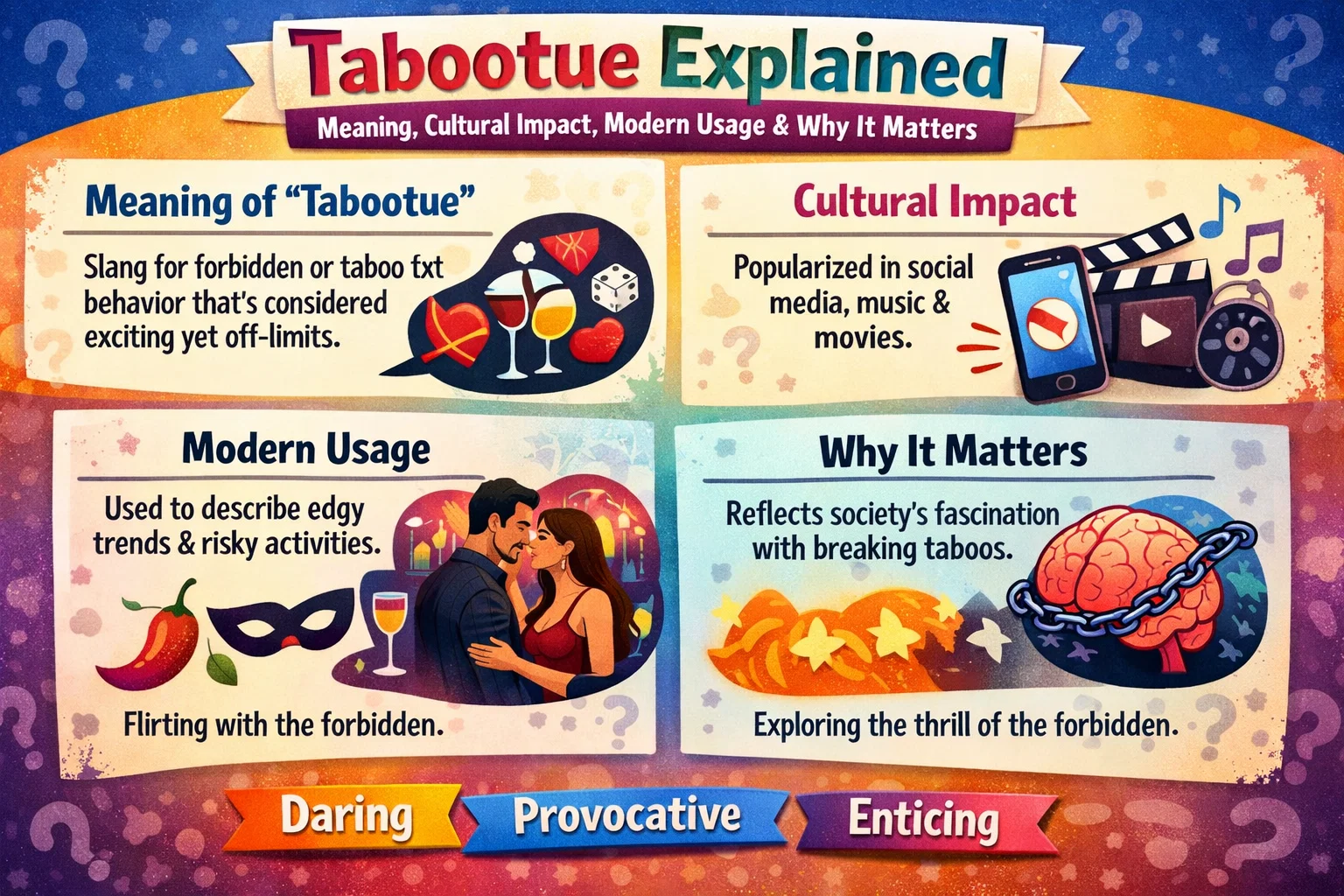
Tabootue is one of those words that feels instinctively powerful even before it is fully explained. It signals boundaries, unspoken rules, cultural tension, and social awareness all at once. Whether encountered in conversations about tradition, media, or personal expression, tabootue carries weight far beyond a simple definition.
In this comprehensive guide, we explore tabootue as a concept, a cultural signal, and a practical framework for understanding why certain topics, behaviors, or expressions trigger discomfort or resistance. By the end, you will understand how tabootue shapes societies, influences communication, and continues to evolve in a hyperconnected world.
Understanding the Core Meaning of Tabootue
At its core, tabootue refers to a subject, action, or expression that is socially restricted or emotionally charged within a specific cultural or social context. These restrictions are rarely arbitrary; they emerge from shared histories, moral frameworks, and collective experiences that shape what a group considers acceptable.
Unlike formal rules or laws, tabootue operates through social pressure and implicit understanding. People often learn it not through instruction but through observation, correction, or silence, which makes it especially powerful and difficult to challenge.
The Linguistic Roots and Evolution of Tabootue
The linguistic evolution of tabootue reflects humanity’s long-standing need to name the invisible lines that govern behavior. Across cultures, similar terms have existed to describe forbidden speech, sacred restrictions, or morally sensitive topics.
Over time, tabootue has expanded beyond its original usage, adapting to new social realities. In modern language, it often blends traditional cultural boundaries with contemporary issues like identity, technology, and power dynamics.
Why Societies Create Tabootue
Societies create tabootue as a form of social self-regulation. By discouraging certain behaviors or discussions, communities aim to preserve harmony, protect shared values, or prevent psychological harm.
This process is not always conscious or coordinated. Often, tabootue forms organically as communities react to historical trauma, religious beliefs, or deeply ingrained moral narratives that define group identity.
Psychological Dimensions of Tabootue
On a psychological level, tabootue triggers strong emotional responses because it is linked to fear of rejection, shame, or social exclusion. People internalize these boundaries early in life, making them feel instinctive rather than learned.
This emotional charge explains why breaking a tabootue can feel transgressive even when no explicit harm is caused. The discomfort often arises not from the act itself, but from violating a shared expectation.
Cultural Variations in Tabootue
What qualifies as tabootue varies dramatically across cultures. A topic openly discussed in one society may be considered deeply inappropriate in another, highlighting how contextual these boundaries truly are.
These differences can create misunderstandings in cross-cultural communication. Recognizing tabootue as culturally relative rather than universally fixed is essential for respectful global interaction.
Tabootue in Family and Community Structures
Within families and local communities, tabootue often governs discussions around money, relationships, mental health, or conflict. These silences can maintain surface-level harmony while hiding unresolved issues beneath.
At the same time, shared tabootue can strengthen group identity. Knowing what not to say becomes a form of belonging, signaling that one understands the group’s unwritten rules.
The Role of Religion in Shaping Tabootue
Religious belief systems have historically played a major role in establishing tabootue. Sacred texts, moral codes, and spiritual authority often define what is considered forbidden or inappropriate.
Even in secular societies, religiously influenced tabootue can persist long after formal belief declines. These lingering norms demonstrate how deeply such boundaries can embed themselves into cultural consciousness.
Tabootue and Power Dynamics
Tabootue is rarely neutral; it often reflects power structures within a society. Those in authority may define certain topics as off-limits to protect their position or avoid scrutiny.
Conversely, marginalized groups may face enforced tabootue that limits their ability to speak openly about their experiences. In this way, tabootue can function as both a protective mechanism and a tool of suppression.
Media, Censorship, and Tabootue
Modern media constantly negotiates tabootue. Journalists, filmmakers, and creators must balance truth-telling with audience sensitivity and regulatory constraints.
As platforms expand globally, navigating tabootue becomes more complex. Content acceptable in one region may provoke backlash in another, forcing media organizations to adapt rapidly.
Tabootue in the Digital Age
The internet has transformed how tabootue operates. Topics once confined to private spaces now circulate widely, challenging traditional boundaries and accelerating cultural change.
At the same time, digital communities create their own Online norms, moderation rules, and social backlash shape what can be discussed, even in spaces that claim openness.
Social Movements and the Breaking of Tabootue
Many social movements begin by challenging tabootue. By naming and discussing previously silenced issues, activists disrupt the comfort of the status quo.
This process is often met with resistance, but it can lead to profound societal shifts. History shows that confronting is frequently a precursor to reform and expanded understanding.
The Risks of Ignoring Tabootue
Completely dismissing tabootue can backfire. Ignoring cultural sensitivities may alienate audiences, damage trust, or escalate conflict.
Effective communication requires awareness, not avoidance. Understanding allows individuals to navigate sensitive topics thoughtfully rather than stumbling into unintended offense.
When Tabootue Protects and When It Harms
Not all tabootue is harmful. Some boundaries protect privacy, dignity, and emotional well-being, especially around grief or trauma.
Problems arise when tabootue prevents necessary dialogue. When silence blocks healing, accountability, or education, the cost of maintaining it becomes too high.
Tabootue in Professional Environments
Workplaces develop their own forms of tabootue, often around compensation, internal politics, or leadership criticism. These unspoken rules influence morale and transparency.
Organizations that consciously examine workplace tabootue can foster healthier cultures. Open dialogue, when structured carefully, often replaces fear with trust.
Education and the Teaching of Tabootue
Education systems play a critical role in transmitting tabootue. What is included or excluded from curricula sends powerful signals about what society values or avoids.
Progressive educational models increasingly encourage critical thinking about helping students understand why certain topics are sensitive and how to approach them responsibly.
Misconceptions Surrounding Tabootue
A common misconception is that tabootue is inherently outdated or irrational. In reality, it often reflects deeply rooted collective experiences.
Another misunderstanding is that breaking tabootue is always courageous. Context matters, and thoughtless disruption can cause harm rather than insight.
Practical Framework for Navigating Tabootue
Navigating tabootue requires curiosity, empathy, and situational awareness. Asking why a topic is sensitive often reveals valuable cultural information.
The goal is not to eliminate but to understand it well enough to engage respectfully. Awareness transforms restriction into insight.
Comparative Overview of Tabootue Across Contexts
| Context | Common Tabootue Themes | Social Purpose | Modern Shift |
| Family | Money, conflict, health | Preserve harmony | Gradual openness |
| Religion | Morality, ritual limits | Spiritual order | Interpretive debate |
| Media | Violence, identity | Audience protection | Context-based framing |
| Workplace | Salaries, authority | Stability | Transparency trends |
This comparison highlights how tabootue adapts to its environment while serving similar social functions across domains.
Expert Perspective on Tabootue
As one cultural anthropologist observed, “Taboos are not walls meant to imprison thought, but mirrors reflecting what a society fears losing.” This insight captures the dual nature of tabootue as both a boundary and a signal.
Understanding this perspective reframes from an obstacle into a diagnostic tool for cultural values.
The Future Evolution of Tabootue
Tabootue will continue to evolve as societies change. Globalization, generational shifts, and technological innovation constantly reshape what is considered sensitive.
Future may emerge around artificial intelligence, data privacy, or human enhancement, proving that this concept is never static.
Conclusion
Tabootue is far more than a social inconvenience or conversational restriction. It is a living expression of collective values, fears, and priorities that shapes how societies communicate and evolve.
By understanding rather than dismissing it, individuals and organizations gain a powerful lens for navigating complexity, fostering respect, and engaging in meaningful dialogue.
Frequently Asked Questions About Tabootue
What does tabootue mean in simple terms?
Tabootue refers to topics or actions that are socially restricted or sensitive, often shaped by culture, history, and shared values.
Is tabootue the same in every culture?
No, varies widely across cultures, with each society defining its own boundaries based on experience and belief systems.
Can tabootue change over time?
Yes, tabootue evolves as social norms shift, new generations emerge, and previously silenced issues gain visibility.
Why do people react strongly to tabootue topics?
Because tabootue is tied to emotional conditioning and social belonging, discussing it can trigger fear of judgment or exclusion.
Should tabootue always be challenged?
Not always; some tabootue protects well-being, while others deserve thoughtful examination. Context and intent matter.